Wednesday, January 03, 2007
posted by pablopabla at 11:08 am
 Spinach Soup with Hawthorn Berries
*Urgent correction!! Oh dear! It is not supposed to be hawthorn berries! It's wolfberries! Where in the world did I get hawthorn berries from? I hope no one has used hawthorn berries and had stomach upset or the like after trying out this recipe. I can't possibly change the title above without getting this post topsy-turvy in the search engines. So, from here onwards, it's wolfberries, ya? Not hawthorn berries. Thanks to Jessie for raising enough suspicion in me that my original post is dodgy* Spinach is a fast-cooking vegetable and packed with nutrients. That's why Popeye loves 'em. It can be stir-fried and it can be cooked in soup. Recently, my dear wife told me that she wanted to try cooking spinach soup with hawthorn berries (a.k.a. kei chee).
Imagine all the goodness from the spinach doubled up with the circulatory benefits of hawthorn berries (get the good quality berries which are slightly plummer and sweeter in taste). It is definitely a power-packed soup. Oh yes, the stock is made from ikan bilis soup. So, there you go. My daughter of 3 1/2 years old loved it. I think you will too!
This is my wife's recipe for
Spinach Soup with Hawthorn BerriesIngredients- 300 grammes of spinach (rinsed and plucked at the stems. Discard old or thick stems)
- 10 grammes of hawthorn berries (about 20 to 30 pieces)
- 100 grammes of minced meat (we use pork)
- 50 grammes of ikan bilis
- 3 soup bowls
Marinade (for minced meat)- 2 teaspoons light soya sauce
- a dash of white pepper powder
Seasoning- Salt to taste
- 2 teaspoons light soya sauce
MethodBoil ikan bilis in water for 30 minutes to make stock. Remove ikan bilis when done. Meanwhile, marinade minced meat.
Bring stock to boil again after removing ikan bilis. Scoop minced meat into meat balls using a teaspoon and add into the stock. Cook till all meat balls float to surface. Add spinach and hawthorn berries and bring back soup to boil. Add seasoning to taste and serve immediately.
Technorati Tags :
Recipe ,
Spinach ,
Pork ,
Chinese Food ,
SoupLabels: Pork, Soup, Vegetable


Tuesday, December 26, 2006
posted by pablopabla at 11:32 am
 Claypot Chicken with Bitter Gourd
This is my mother's recipe. I've never acquired the taste for bitter gourd all these years though I know it is packed with nutrients and goodness. I am informed that this dish - Chicken with Bitter Gourd is a favourite amongst many who like bitter gourd. I am also informed that the bigger and older the bitter gourd, the less bitter it is.
So, I thought why not I post it up here on this blog for those who like to eat chicken with bitter gourd but do not know how to cook it. My mum used the claypot to retain the warmth of the dish as well as to ensure that the chicken and bitter gourd continue to simmer slowly though it has been removed from the cooker. If you don't have a claypot, it doesn't really matter. Just serve it on a plate.
This is my mother's recipe for
Claypot Chicken with Bitter Gourd.
Ingredients- 1 large bitter gourd (wash, remove seeds, cut halved across the bitter gourd and then, cut to chunk bite sizes)
- 2 whole chicken legs (remove skin and cut to chunky bite sizes. You can keep the skin if you don't mind the dish slightly oily)
- 5 pieces dried chinese mushrooms (pre-soaked till soft and cut to two with stems discarded)
- 1 1/2 tablespoons tau cheo
- 4 cloves garlic (chopped)
- 2 tablespoons cooking oil (preferably palm oil)
- 1 cup warm water
Seasoning- 1 1/2 teaspoons dark soya sauce
- Salt to taste
- a pinch of sugar
MethodHeat oil in wok and stir-fry garlic and tau cheo for 30 seconds. Add chinese mushrooms, chicken and bitter gourd and continue stir-frying till outer layer of chicken meat is cooked.
Add seasoning and water enough to cover the ingredients. Bring to boil. Meanwhile, if you have a claypot, heat it up whilst waiting for the gravy to boil in the wok.
Once the gravy is boiling, transfer contents into claypot and simmer for 15 minutes on medium heat till gravy reduced to your liking. If you do not have a claypot, simmer likewise.
Serve hot with white rice.
Technorati Tags :
Recipe ,
Bitter Gourd ,
Claypot ,
ChineseLabels: Chicken, Dinner, Vegetable
Thursday, December 21, 2006
posted by pablopabla at 4:01 pm
 Stir-Fried Instant Noodles
Whilst instant noodles can be REALLY EASY to cook, you can actually make a slightly more elaborate dish out of it by adding some ingredients which blend nicely with the springy texture of the instant noodles. For this recipe, I use bean sprouts, carrots and capsicum to give it a bit of crunch and fibre and I also add sliced fish cake for added flavour.
 Ingredients
There are actually two parts to cooking this dish. The first part would be to cook the instant noodles in boiling water till al-dente (which is cooked but not soggy or soft). After cooking the noodles in boiling water, drain it and run it under cold / tap water to stop the noodles from cooking further. Running it through the cold / tap water also makes the noodles springy in texture.
 Close-Up of a piece of Fish Cake
The second part involves the stir-frying of the ingredients together with the noodles. You will need a cooker which gives you really high heat or else, the noodles might stick to your wok. And if you used the wok to boil the noodles, I would recommend that you fry some sliced shallots in that wok, remove the oil and shallots and wash the wok before proceeding to stir-fry the instant noodles. Frying the shallots or even an egg for that matter will somehow "recondition" the wok to be less sticky.
This is my recipe for
Stir-Fried Instant NoodlesIngredients- 4 pieces of instant noodles (cooked by boiling as per above paragraph)
- 1 piece or more of fish cake (sliced) (substitute with whatever meat you want)
- 1/2 piece of capsicum (sliced thinly)
- An equal amount of carrots or more (julienned)
- 300 grammes of bean sprouts (rinsed and root removed)
- 2 stalks of spring onions (cut to 3 inch lengths)
- 4 cloves of garlic (chopped)
- 2 eggs
- 3 tablespoons of cooking oil (preferably palm oil)
Seasoning- 1 tablespoon of oyster sauce
- 1/2 tablespoon of light soya sauce
- 1/2 teaspoon of salt
- 1/4 teaspoon of white pepper powder
- 1/2 teaspoon of dark soya sauce
MethodHeat oil in wok and saute garlic together with sliced fish cake till garlic begin to brown. Break the eggs over the sliced fish cake and gently stir till egg is thoroughly cooked. Add carrots and capcisum and stir-fry for 1 minute.
Add cooked noodles and seasoning and stir-fry for 1 minute to ensure that seasoning is evenly distributed. Sprinkle some warm water if the noodles are drying out or burning. Sprinkle the spring onions onto the noodles and stir evenly.
Dish out and serve hot with cut chillis.
Technorati Tags :
Recipe ,
Noodles ,
Stir-Fry ,
ChineseLabels: Chinese, Dinner, Lunch, Noodles, Vegetable
Friday, December 15, 2006
posted by pablopabla at 4:02 pm
 Mui Choy Bak
Mui Choy, which is preserved mustard cabbage, comes in two variants - salty type as well as the sweet type. It is normally sold in sundry shops and wet market grocers (unsealed) or in sealed bags in supermarkets. In Malaysia, it is usually sold in wet market grocers. Whichever type you use, make sure you wash and soak them (especially the salty type).
This dish is great eaten with mantou (a type of bun) or with plain white rice. In fact, it even tastes better overnight as the meat would have soaked all the exquisite sweet-salty taste from the cabbage.
This is my recipe for
Mui Choy Bak (Mui Choy with Pork Belly)Ingredients- 1/3 piece salty mui choy (washed thoroughly, soaked for 30 minutes and chop to small pieces)
- 2/3 pieces sweet mui choy (washed thoroughly, soaked for 15 minutes and chop to small pieces)
- 500 grammes pork belly without skin (also known as three-layered pork, cut to small cubes)
- 2 whole garlic (smash it a bit with the side of a cleaver / chopper)
- 1/2 tablespoon cooking oil (preferably palm oil)
- Warm water
Seasoning- 2 to 3 tablespoons of dark soya sauce (or more if you prefer)
- Sugar and salt to taste (if necessary)
MethodHeat oil in pot and stir-fry pork belly till beginning to brown. Add mui choy and garlic and continue stir frying for another 1 to 2 minutes. Add water to cover all the ingredients by at least 1 cm and seasoning.
Simmer for at least 1 hour or more till meat is flavourful and slightly soft, checking that the dish does not dry out occasionally. You can also add dried chillis at the stir-frying stage if you want a little spiciness to this dish.
For picture of mui choy and a quite similar method of cooking, click
here.
Technorati Tags :
Recipe ,
Chinese Food ,
Mui Choy ,
PorkLabels: Pork, Vegetable
Wednesday, December 06, 2006
posted by pablopabla at 4:35 pm

Stir-Fried Dwarf Bok Choy with Garlic and Dried Prawns
Lately, Dwarf Bok Choy is commonly sold in markets. Bok Choy or Pak Choy is a commonly cooked vegetable in chinese cuisine. Generally, the vegetable has dark green leaves and white or greenish spoon-shaped stems. Siew Pak Choy (Small Pak Choy) is a favourite to many and has greenish coloured stems whilst the Tai Pak Choy (Big Pak Choy) has a darker green leave atop white coloured stems. Dwarf Bok Choy, I believe, is a miniature version of the Tai Pak Choy, which you can see in the picture.
 Dwarf Bok Choy
I find the Dwarf Bok Choy sweeter in taste rather than the more bitter Tai Pak Choy. That is not to say that it tastes sweet but rather, bitter sweet. I usually cook this vegetable with garlic and dried prawns. Somehow, I find the combination of garlic and dried prawns bring out the nice bitter sweet flavour of the vegetable. I also understand that cooking with dried prawns enable the vegetable to cook faster. You will notice that I do not use any seasoning as I prefer the original flavour from the garlic and dried prawns. The dried prawns are in itself, slightly salty.
This is my recipe for
Stir-Fried Dwarf Bok Choy with Garlic and Dried PrawnsIngredients- Approximately 200 grammes of dwarf bok choy (wash and rinse to remove dirt)
- 5 cloves garlic (chopped)
- 30 grammes of dried prawns (rinsed for a couple of seconds, pre-soaked in 50 ml water for 20 minutes - retain water for cooking)
- 1 tablespoon of cooking oil (palm oil preferred)
MethodHeat oil in wok and stir-fry the dried prawns for about 10 seconds. Add garlic and continue stir-frying till garlic begin to brown. Add dwarf bok choy and stir-fry for another 15 seconds or so. Add the water (previously used to soak dried prawns) and close lid.
Cook dwarf bok choy according to how soft you want the stems to be. Add a little water if you wish to have more gravy and add salt to taste (if not already salty).
Technorati Tags :
Vegetable ,
Bok Choy ,
Recipe ,
Chinese Cooking ,
Stir-FryLabels: Dinner, Lunch, Vegetable
Monday, December 04, 2006
posted by pablopabla at 3:16 pm

Stir-Fried Mixed Vegetables - Sugar Snap Peas, Baby Corn, Carrots and Mushrooms
Sugar Snap Peas are sweet tasting, crisp and succulent and make a good mixed vegetable dish. They have a thicker pod compared to the snap peas and the seeds are larger and sweeter. However, you will have to match it with the right ingredients to get a nice combination of taste and texture. In this recipe, I have mixed it with baby corns (absolutely wonderful and sweet tasting, yet crunchy), carrots (highly nutritious and sweet) and chinese dried mushrooms / shiitake mushrooms (smooth, smoky flavoured and absorbs the gravy well) for a delicious and healthy stir-fry. You can substitute the mushrooms with any other type of mushrooms eg. straw mushrooms, button mushrooms or golden needle mushrooms.
 Sugar Snap Peas
When preparing the snow peas, do remove the tips either using your fingers or with a small knife. Try to remove the stringy fibre which runs across both sides of the pod by pulling the tip across. It's like unzipping the pod, only that the pod stays intact and the seeds remain inside.
The timing indicated for cooking below is only an estimate and it also depends on the intensity of the heat that your stove gives. You can adjust the timing to cater for your preferred softness of the vegetables. I like my sugar snap peas crispy, so I do not cook them for a long time.
This is my recipe for
Stir-Fried Mixed Vegetables - Sugar Snap Peas, Baby Corn, Carrots and Mushrooms- 100 grammes sugar snap peas (about 20 pieces, remove tip and fibre which runs across the pod)
- 8 pieces of baby corn (sliced lengthwise to quarters)
- Carrots (sliced - amount to your desire)
- 5 pieces chinese dried mushrooms (pre-soaked till soft)
- 3 cloves garlic (chopped)
- 1 tablespoon cooking oil (palm oil preferred)
- 30 ml of water or more
- Corn starch (prepared using 1 tablespoon of corn flour mixed with 5 tablespoons of water)
Seasoning- 1 tablespoon oyster sauce
- salt to taste
- a couple of dashes of white pepper powder
- 2 teaspoons chinese cooking wine
MethodHeat oil in wok and stir fry the garlic together with the mushrooms till garlic begins to brown. Add baby corn and carrots and continue to stir fry for another 30 seconds while adding 1 to 2 tablespoons of water.
Add seasoning and semi-cover vegetables with warm water and close lid to allow vegetables to cook. Periodically check for drying out. After about 1 1/2 minutes or when gravy almost dried out, add sugar snap peas and another 3 tablespoons of water, stir well and close lid again. Sugar snap peas are done when the pod is breaking and has turned darker green in colour. Add a little bit of corn starch is gravy is too runny for your liking.
Serve hot with white rice.
Technorati Tags :
Vegetables ,
Peas ,
Recipe ,
Chinese Food Labels: Vegetable
Tuesday, November 28, 2006
posted by pablopabla at 5:43 pm
 Stir-Fried Yau Mak with Garlic
I like vegetables. I think I am okay with all types of vegetables except the obvious bitter ones eg. bitter gourd. I know it is good for health but I usually give it a pass. Not with green leafy vegetables though.
There are many varieties of lettuce around and most of them can be eaten raw or cooked. If you intend to stir-fry the lettuce, make sure that your wok is really heated up to very high temperature (smoking) so as to minimise cooking time and to prevent too much water oozing out from the leaves. The idea is not to have the vegetables swimming in a pool of gravy. You also lose a lot of essential vitamins and minerals by prolonged cooking of the vegetables. Here, I use a type of lettuce known as "Yau Mak" which is a slightly smaller version of the romaine lettuce. I should have taken a photo of it before the leaves were separated and rinsed.
This is my recipe for
Stir-Fried Yau Mak with GarlicIngredients- 2 pieces yau mak (or to your desired amount but bear in mind that they will shrivel and reduce in size as you cook, separate leaves and rinse well. Drain in colander to remove excess water)
- at least 5 cloves of garlic (chopped)
- 4 cloves of shallots (sliced thinly)
- 3 tablespoons of palm oil
Seasoning- 1 1/2 tablespoons of oyster sauce
MethodHeat up oil in wok and fry shallots till golden brown. Remove fried shallots aside.
Add garlic into remaining oil and stir fry for about 10 seconds followed by yau mak. Give it two or three stirs and add oyster sauce. Stir till leaves are evenly coated with sauce. I like the leaves crunchy, so I do not usually stir fry them for more than 1 minute.
Sprinkle fried shallots prior to serving.
Technorati Tags :
Lettuce ,
Recipe ,
Chinese FoodLabels: Dinner, Lunch, Vegetable
Thursday, November 23, 2006
posted by pablopabla at 10:54 am
 Steamed Chicken with Carrots, Wood-Ear Fungus, Dried Lilybuds and Mushrooms
Remember I used to have a recipe called
Mixed Vegetables - Cabbage, Carrots, Wood-Ear Fungus, Dried Lily Buds and Mushrooms? Well, I am going to modify that recipe a bit instead. Using most of the same ingredients, these will be steamed together with chicken to make a nice healthy dish.
In this dish, the chicken is sweet-tasting and has a hint of chinese cooking wine as it was marinated prior to steaming. The meat will usually be tender when cooked as whole chicken leg (drumstick and thigh meat) is used and the wine further tenderises the meat. This is in contrast with the crispness of the wood-ear fungus, sweetness of the carrots and lily buds and smoky taste of the mushrooms. Truly, it comes with a riot of taste and goes well with steamed white rice.
Actually, as emphasised in most of my recipes, you don't actually have to follow the ingredients in full especially if you have difficulty finding them at the place you live. Just use a bit of creativity and substitute them with different ingredients. If you are not sure, feel free to ask me at the comment section below.
This is my recipe for
Steamed Chicken with Carrots, Wood-Ear Fungus, Dried Lilybuds and Mushrooms.
Ingredients- 2 whole chicken legs (chopped into bite pieces)
- 1 small sized carrot (sliced)
- 50 to 100 grammes of wood-ear fungus (pre-soaked till soft)
- 5 dried chinese mushrooms (pre-soaked till soft) or enoki, oyster or button mushrooms
- 50 grammes of dried lily buds (pre-soaked till soft and knotted in the middle)
- 1 whole bulb of garlic (chopped)
- 1 tablespoon of cooking oil (preferably palm oil)
Marinade for chicken- 1 tablespoon of oyster sauce
- 2 teaspoons of light soya sauce
- A couple of dashes of white pepper powder
- 1 tablespoon of chinese cooking wine
- 1 tablespoon of corn flour
Seasoning- 1 tablespoon of oyster sauce
- Salt to taste
MethodMarinade the chicken for about an hour.
Heat oil in wok, followed by garlic and chinese mushrooms. Fry till garlic begins to brown. Add carrots, wood-ear fungus and lily buds. Stir-fry for 2 minutes. Remove and set aside.
Place chicken on a suitable plate for steaming
(I use a stainless steel plate as seen in the picture above). Place the pre-stirfried vegetables on top of the chicken. Steam in wok / steamer for at least 20 minutes or until chicken is thoroughly cooked.
Technorati Tags :
Chicken ,
Vegetable ,
Recipe ,
Chinese FoodLabels: Chicken, Dinner, Vegetable
Wednesday, November 22, 2006
posted by pablopabla at 1:31 pm
 A B C D Soup
There is a famous soup called ABC Soup which is essentially a combination of cubed potatoes, carrots, tomatoes and onions cooked in meat stock (usually pork or chicken). After my posting on
Hot and Sour Szechuan Vegetable Soup recently,
Tummythoz, girlgirl and
tekko informed me that they add carrots and even corn into the soup. That was new to me.
So, when I went home to my mum's place last night, I was most surprised to see a bowl of Szechuan Vegetable Soup which has carrots, onions and potatoes in it! It is indeed a marriage of the Hot and Spicy Szechuan Vegetable Soup with the famed ABC Soup! And true enough, it has the hot and sourness of the szechuan vegetables and the sweetness of the ABC soup. I shall call it the A B C D Soup then!
It is another one of those simple-to-cook yet appetising soup which is great on a cold weathered day!
This is the recipe for
A B C D Soup.
Ingredients- 200 to 300 grammes of meat (pork ribs or suitable cuts or chicken parts)
- 2 medium sized potatoes (washed, skin removed and cubed in big chunks)
- 1 carrot (cut in big pieces)
- 2 large tomatoes (quartered)
- 2 large onions (quartered)
- 1 piece szechuan vegetable (washed and sliced)
- 2 bowls of water (approximately 800 ml to 1 litre)
MethodBring water to boil. Add meat and let water reboil. Remove layer of scum from surface of water.
Add the rest of the ingredients, bring to boil again for 5 minutes and then lower heat to simmer for at least 1 hour or longer.
You don't really need to add any seasoning to this soup as the various ingredients will impart its taste.
Technorati Tags :
Soup ,
Recipe ,
Chinese FoodLabels: Soup, Vegetable
Thursday, November 16, 2006
posted by pablopabla at 10:45 am
 Hot and Sour Szechuan Vegetable Soup
Got szechuan vegetable in your kitchen? Why not cook soup with it? Szechuan vegetable which is preserved with chilli and salt imparts a distinct flavour when cooked in soup. The soup will be spicy hot and salty. When you add a couple of tomatoes into the soup, it's be hot and sour. Definitely appetising especially when eaten with
long bean rice or even
cabbage rice.
Depending on how hot or salty you want your soup to end up, you can actually wash or even soak the preserved szechuan vegetable prior to cooking. I usually just wash the szechuan vegetable rather than soaking as I like the original taste of the preserved vegetable. My mum adds a couple of cloves of garlic for added taste but I don't really fancy that. You can try it if you want.
This recipe is simple and not intimidating for first timers!
This is my recipe for
Hot and Sour Szechuan Vegetable Soup.
Ingredients- 1 piece szechuan vegetable larger than the size of an egg (washed and sliced)
- 3 - 4 large tomatoes (quartered)
- 50 to 100 grammes of minced pork or pork ribs or chicken parts
- 2 soup bowls or 600 ml of water
MethodBring water to boil and add sliced szechuan vegetables and tomatoes. If you are using pork ribs or chicken parts, add them now. Simmer for 1 hour or more till water reduced to approximately 1 soup bowl.
If using minced pork, 3 minutes before intended serving, bring back to boil and add minced pork shaped into small balls.
Serve steaming hot.
How about stir-frying the szechuan vegetable? My recipe for Stir-Fried Pork with Preserved Szechuan Vegetable here.
Technorati Tags :
Soup ,
Recipe ,
Szechuan Vegetable ,
Chinese FoodLabels: Dinner, Soup, Vegetable
Tuesday, November 14, 2006
posted by pablopabla at 4:30 pm
 Cabbage Rice with Lap Cheong
This is my 3rd recipe for rice cooked in a rice cooker. Prior to this, I have a recipe for
Chicken Rice as well as
Long Bean Rice. This is another one of the vegetable rice recipes which can serve as a meal on its own.
Cabbage Rice with Lap Cheong (Chinese Sausages) is quite mild in flavour but sweet in taste. The sweetness comes from the cabbage. The type of cabbage we usually use is the chinese cabbage, which is white in colour and longish in shape rather than round. Try not to leave the rice uneaten overnight as I believe that the cooked cabbage does not withstand being kept overnight that well.
If you don't have lap cheong, you can even substitute it with ham or even salami! Do experiment. As I have emphasised many times before in my recipes, you can actually experiment with the ingredients once you get the basic idea of how the dishes are cooked. The presentation of the rice in the picture above could be much better but the taste definitely is!
This is my recipe for
Cabbage Rice with Lap Cheong (Chinese Sausages)
Ingredients- 2 cups rice pre-soaked for 30 minutes (measured using the cup that comes with your rice cooker)
- About 400 grammes of chinese cabbage (shredded roughly)
- 400 grammes of belly pork (try to get the 3-layered pork. Remove skin)
- 5 to 8 pieces dried chinese mushrooms (pre-soaked till soft. Remove from water and cut to slivers but retain water for later use)
- 50 grammes of dried prawns / shrimps (pre-soaked for 5 minutes. Remove from water but retain water for later use)
- 3 to 5 lap cheong (remove skin and slice thinly diagonally)
- 5 cloves shallots (sliced thinly)
- 2 tablespoons of cooking oil (preferably palm oil)
- 3 bowls of water
Seasoning- 4 teaspoons salt
- 1/2 teaspoon white pepper powder
- 2 teaspoon light soya sauce
- 2 tablespoon dark soya sauce
- A pinch of msg (optional)
MethodBring water to boil. Add belly pork and let it boil till cooked. Remove pork. Cut into small pieces.
Heat oil in wok and fry shallots till golden brown. Remove fried shallots.
With remaining oil in wok, fry the cooked belly pork till beginning to brown. Remove pork. With remaining oil, fry the dried prawns and chinese mushrooms for 1 minute till fragrant. Add cabbage and put back the pork into the wok and continue to stir fry for 1 more minute. Add seasoning and a little bit of water (used to soak mushrooms / dried prawns) to keep it moist.
Add pre-soaked rice into the ingredients and stir well for 1 minute.
Transfer the ingredients into rice cooker and add water till it covers rice completely just like how you usually cook rice. Turn on the rice cooker. Check occasionally for water to dry out from the upper layer of the rice. Once that happens, place lap cheong on top of the rice, cover lid and wait for rice to cook completely.
Sprinkle fried shallots over rice before serving.
Technorati Tags :
Recipe ,
Rice ,
Recipe ,
Chinese FoodLabels: Dinner, Rice, Vegetable
Wednesday, November 08, 2006
posted by pablopabla at 2:52 pm
 Sambal Belacan Ladies Finger
Ladies finger, also known as Okra, is a fibrous pod full of round white seeds.
Packed with vitamins and minerals, it is often used in Asian cuisine especially in India. Back home in Malaysia, it is commonly added to Assam Fish or Curry Fish. It is also cooked as a dish of its own and I usually stir-fry it with belacan sambal.
 Ladies Finger or Okra
When choosing ladies finger, choose the younger pods which are usually lighter green in colour and smaller in size. Usually, the younger pods will have softer fur-like skin. These younger pods are more tender in texture and less fibrous.
And again, just like
Kangkong Belacan, you should cook this dish using really high heat as you want to cook it in minimum time to preserve its juice.
This is my recipe for
Sambal Belacan Ladies FingerIngredients- Approximately 15 pieces of ladies finger (washed and sliced diagonally. Discard top / head)
- A pinch of sugar
- 50 ml warm water
- 2 tablespoons cooking oil (preferably palm oil)
Sambal belacan mix (pound / blended together)- 50 grammes dried prawns / shrimps (pre-soaked for 10 minutes to soften)
- 20 grammes of belacan (buy from stores)
- 5 to 8 cloves garlic
- 5 to 8 cloves shallots
- 3 to 5 red chillis (remove seeds if you want the sambal to be less hot)
MethodHeat oil on wok at medium heat. Stir-fry the sambal belacan mix for about 2 minutes.
Increase heat to high and add ladies finger and sugar. Stir well for about 2 minutes or till the ladies finger is to your desired softness. Add a little water at a time if sambal belacan mix beginning to burn. As the sambal belacan mix contains dried prawns and belacan which are salty in itself, it may not be necessary to add salt.
Technorati Tags :
Ladies Finger ,
Okra ,
Recipe ,
VegetableLabels: Dinner, Lunch, Vegetable
Monday, November 06, 2006
posted by pablopabla at 2:17 pm
 Stir-Fried Pea-Sprouts with Garlic
Pea-Sprouts are also known as "Tou Miau" in Mandarin. Rich in vitamins and minerals, it is considered one of the easiest vegetable to stir-fry. Popular in many Chinese restaurants, the prices of these pea-sprouts have risen over the years due to its high demand.
 Fresh Pea-Sprouts
When cooking this dish, it is important to have the wok heated at high as you need to cook the pea-sprouts in minimum time to preserve its nutrients and to ensure that the juices are retained in the sprouts. Else you will have a flooded dish!
This is my recipe for
Stir-Fried Pea Sprouts with GarlicIngredients- 300 grammes pea-sprouts (rinse with water to remove dirt prior to cooking)
- 5 to 8 cloves garlic (chopped finely)
- 2 tablespoons cooking oil (preferably palm oil)
Seasoning- 1 1/2 teaspoons oyster sauce
- Salt to taste
- A dash of white pepper powder
MethodHeat wok till wok starts to smoke.
Add oil followed by garlic. Give the garlic a few quick stir and add the pea-sprouts.
Continue to stir-fry briskly whilst adding seasoning. Cook until pea-sprouts begin to wilt to your desired softness or reduced by 1/2 in bulk. Add one or two tablespoons of warm water if you prefer some gravy.
Technorati Tags :
Pea Sprouts ,
Vegetable ,
Chinese Food Labels: Dinner, Vegetable
Wednesday, November 01, 2006
posted by pablopabla at 3:10 pm
 Stir-Fried Kai-Lan Stems with Pork and Mushrooms
"Oh no! Not another recipe with mushrooms!" Ha! Ha! Well, can't help it when I have a lot of mushrooms at home. Chinese dried mushrooms to be precise. But anyway, the mushrooms here are the supporting act. The main actor is the Kai Lan stems.
According to the
Wikipedia,
Kai-lan, also known as
Chinese broccoli or
Chinese kale, is a slightly bitter leaf vegetable featuring thick, flat, glossy blue-green leaves with thick stems and a small number of tiny, almost vestigial flower heads similar to those of broccoli. As a group of
Brassica oleracea kai-lan is of the same species of plant as
broccoli and kale. Its flavor is very similar to that of broccoli, though not identical, being a bit sweeter.
In this recipe, I use the kai-lan stems. These are usually imported and sold in supermarkets. Unfortunately, I forgot to take a picture of it prior to cooking. What you get is a stem roughly 15 to 20cm long and with very little or no leaf. It tastes much sweeter than the leaves in "normal" the normal kai-lan vegetable. I am told that this variety of kai-lan is grown specifically for its crunchy and sweet tasting stem.
The ideal way to cook this stem is to stir-fry it with medium or large sized prawns which have been deveined and cut "butterfly style". If you are rich enough, you can consider adding scallops! As I don't have any prawns at home when I decided to cook this dish and I am not rich enough to consider scallops, I used pork and mushrooms as the supporting cast.
This is my recipe for
Stir-Fried Kai-Lan Stems with Pork and MushroomsIngredients- 3 to 5 kai-lan stems (lightly scrape the layer of skin from the stem and slice diagonally)
- 50 grammes of pork tenderloin (sliced thinly)
- 2 to 3 pre-soaked chinese mushrooms
- 4 cloves garlic (chopped finely)
- 1 tablespoon of palm oil
- 1/2 cup warm water
- 2 teaspoons cornflour mixed with 1/2 cup water to make corn starch
Marinade for pork tenderloin- 2 teaspoon light soya sauce
- a pinch of white pepper powder
- 1 teaspoon corn flour
Seasoning- 1 tablespoon oyster sauce
- Salt to taste
- 2 teaspoons chinese cooking wine (optional)
- A dash of white pepper powder
MethodMarinade pork tenderloin for 30 minutes.
Heat oil in wok and fry garlic till beginning to brown. Remove garlic from oil.
Add pork tenderloin and chinese mushrooms into remaining oil in wok and stir fry for 1 minute. Add kai-lan stems and pre-fried garlic and stir-fry briskly for 1 minute. Add one or two teaspoons of warm water to prevent burning.
Add seasoning
(except chinese cooking wine) followed by remainder of water and cover lid. Allow to cook for 1 to 2 minutes whilst checking occasionally for drying out of gravy.
Once the stems have more or less turned to a darker colour, add chinese cooking wine and stir well. If the sauce is too thin to your liking, add a little bit of corn starch to thicken it.
Serve hot with white rice.
Technorati Tags :
Kai Lan ,
Vegetable ,
Chinese Food ,
RecipeLabels: Dinner, Lunch, Vegetable
Tuesday, October 31, 2006
posted by pablopabla at 5:14 pm
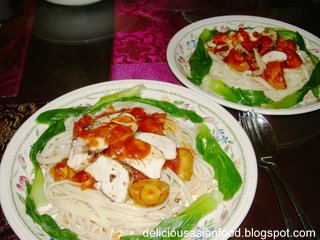 Linguine with Pan-Fried Chicken Breast and Siew Pak Choy
What do you do if you have linguine (a type of pasta), chicken and siew pak choy? Cook them into a dish, of course! It will be handy if you have a can of pasta sauce in your kitchen cabinet.
This dish takes me 1 hour to prepare and cook. I am still an amateur and take a longer time to prepare the ingredients and cook them. Briefly, what I have prepared is pan-fried chicken breast, blanched siew pak choy and pasta sauce. Each can be a dish by itself but this is sort of a fusion dish using western and eastern ingredients. In fact, this is the first time I cooked this dish and I was quite pleased! (I am usually quite fussy over the quality of food I cook. My wife will attest to that!)
 Glorious Siew Pak Choy
I hope you will give this dish a try and having learnt it, experiment on your own with the ingredients.
This is my recipe for
Linguine with Pan-Fried Chicken Breast and Siew Pak Choy.
Ingredients- 250 grammes of linguine (you can use any type of pasta)
- 1 large chicken breast
- 200 grammes of siew pak choy (wash and clean)
- 1 can of button mushrooms (halved)
- 1 can of Campbells Pasta Sauce (tomato, garlic and basil sauce)
- 2 large onions (chopped)
- 5 tablespoons of olive oil
- 1 tablespoon of palm oil
- 1 pot of water
Marinade for chicken- 1 teaspoon salt
- 1/4 teaspoon white pepper powder
- A dash of Lea & Perrins Worcestershire Sauce
- 1 tablespoon of HP BBQ Sauce
- A dash of black pepper powder
- 1 teaspoon of corn flour
Seasoning for tomato-based sauce- Salt to taste
- Black pepper powder to taste
MethodMarinade chicken breast for at least 1 hour or more.
Bring water to boil in a large pot. Add 1 teaspoon of salt and 1 tablespoon of palm oil. Add in the siew pak choy and blanch till the leaves turn dark green / cooked. Remove the leaves and set aside.
Cook the linguine in the pot of water according to directions on packaging. Remove and drain. Set aside and drizzle 2 tablespoons of olive oil over it.
Heat 2 tablespoons of olive oil in frying pan and fry the chicken breast for at least 2 minutes on each side. Ensure chicken breast is thoroughly cooked by piercing the meat with a fork. Clear juice should flow when pierced. Remove from pan to cool. Slice the pan-fried chicken breast.
Heat up 1 tablespoon of olive oil on a sauce pan and saute the onions till translucent. Add button mushrooms and stir well for 2 minutes. Add the pasta sauce and seasoning and bring to boil. Add half-can of water. Cover with lid, reduce heat and simmer for 15 minutes.
Arrange cooked linguine on plate. Place sliced pan-fried chicken breast and siew pak choy to your liking. Pour an appropriate amount of the mushroom tomato pasta sauce over them and serve hot.
Technorati Tags :
Pasta ,
Vegetable ,
RecipeLabels: Chicken, Dinner, Lunch, Pasta, Vegetable
posted by pablopabla at 10:29 am
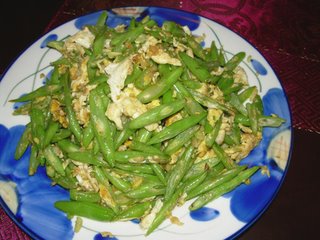
Stir-Fried French Beans with Egg
This is another simple dish to cook but great tasting. French beans can be cooked in many different ways including blanching and steaming but I find it most delicious when it is stir-fried with garlic and egg.
The crunchiness and sweetness of the french beans mixed with the fluffy-fried eggs gives this dish a good balance in taste and texture, not to mention the healthiness. Try choosing the younger and lighter green french beans which are younger, tender and less fibrous compared to the older and darker coloured variety.
 Thinly sliced french beans
Cooking time varies depending on how thinly you slice the french beans diagonally. Obviously, cooking time is lesser if you slice it thinly. You will also have to manage the heat from the cooker as you do not want to burn the garlic.
This is my wife's recipe for
Stir-Fried French Beans with Egg.
Ingredients- 150 - 200 grammes french beans (sliced diagonally thinly)
- 1 large egg
- 4 cloves garlic
- 2 tablespoons of cooking oil (preferably palm oil)
Seasoning- Salt to taste
- White pepper powder to taste
MethodHeat 1 tablespoon of oil in wok on medium heat. Lightly stir fry the garlic till it begins to brown. Add french beans and stir fry at medium high heat for 1 - 2 minutes. If garlic is browning fast, reduce heat. Sprinkle seasoning to taste.
Make a well in the wok (i.e. move the french beans from the center of the wok), increase to high heat and add 1 tablespoon of oil. Break egg into the oil and let it fry till semi-solid. Mix and stir french beans into the semi-solid egg and fry for 30 seconds or so.
Remove from wok and serve hot with rice or plain porridge.
Technorati Tags :
French Bean ,
Vegetable ,
Chinese FoodLabels: Dinner, Lunch, Vegetable
Tuesday, October 17, 2006
posted by pablopabla at 5:05 pm
 Foreground : Long Bean Rice
Background : Kiam Chye Tau Foo SoupRice cookers are not meant just to cook plain rice. Prior to this, I have a recipe for
Chicken Rice cooked in a rice cooker. Apart from Chicken Rice, you can also cook other types of rice, one of which is Long Bean Rice.
 Ingredients
A meal on its own, you will find out here that you can also cook a soup as a side dish arising out of the use of the ingredients here. I will give the recipe for the soup another day. Anyway, the fact that all the ingredients are firstly stir-fried and then cooked in the rice cooker gives the whole dish maximum flavour from the various ingredients used.
 Place into rice cooker before turning on the cooker
Long Beans can be stir-fried on its own with belacan or even garlic and is highly nutritious. Eat too much, however, you may end up with too much gas in your stomach which is common among beans. Once you master this dish, you can substitute the long beans with other vegetables such as cabbage, pumpkin or even "kua chye" - I am still trying to find out what's the anglo-name for this vegetable.
This is my recipe for
Long Bean Rice.
Ingredients- 2 cups rice pre-soaked for 30 minutes (measured using the cup that comes with your rice cooker)
- About 15 pieces of long beans (cut to 2 inch lengths)
- 400 grammes of belly pork (try to get the 3-layered pork. Remove skin)
- 5 to 8 pieces dried chinese mushrooms (pre-soaked till soft. Remove from water and cut to slivers but retain water for later use)
- 30 grammes of dried prawns / shrimps (pre-soaked for 5 minutes. Remove from water but retain water for later use)
- 5 bulbs shallots (sliced thinly)
- 2 tablespoons of cooking oil (preferably palm oil)
- 3 bowls of water
Seasoning- 4 teaspoons salt
- 1/2 teaspoon white pepper powder
- 2 teaspoon light soya sauce
- 1 tablespoon dark soya sauce
- A pinch of msg (optional)
MethodBring water to boil. Add belly pork and let it boil till cooked. Remove pork. Cut into small pieces.
Heat oil in wok and fry shallots till golden brown. Remove fried shallots.
With remaining oil in wok, fry the cooked belly pork till beginning to brown. Remove pork. With remaining oil, fry the dried prawns and chinese mushrooms for 1 minute till fragrant. Add long beans and put back the pork into the wok and continue to stir fry for 1 more minute. Add seasoning and a little bit of water (used to soak mushrooms / dried prawns) to keep it moist.
Add pre-soaked rice into the ingredients and stir well for 1 minute.
Transfer the ingredients into rice cooker and add water till it covers rice completely just like how you usually cook rice. Turn on the rice cooker and wait for it to cook automatically.
Sprinkle fried shallots over rice before serving.
Technorati Tags :
Recipe ,
Rice ,
Recipe ,
Chinese FoodLabels: Dinner, Rice, Vegetable
Tuesday, October 10, 2006
posted by pablopabla at 4:32 pm
 Mixed Vegetables
I have not been posting since the 2nd October. Not that I have not eaten but I have not been cooking and I have not eaten anything which I deem interesting enough to share it here. Recently though, my mum cooked Mixed Vegetables consisting of cabbage, carrots,
wood-ear fungus, mushrooms and dried lily buds (kim cham).
Dried lily buds are unopened flower buds of lilies and also known as "golden needles". The buds need to be soaked in water for at least 30 minutes followed by tying itself in a knot at the middle. The wood-ear fungus also need to be soaked in water till soft prior to cooking as they come in dried form.
This is the recipe for
Mixed Vegetables using Cabbage, Carrots, Wood-Ear Fungus, Chinese Mushrooms and Dried Lily Buds.
Ingredients- 300 grammes of cabbage (cut across into 1 inch width)
- 200 grammes of carrot (sliced)
- 50 to 100 grammes of wood-ear fungus (soaked in water till soft)
- 5 dried chinese mushrooms (pre-soaked in 1 large bowl of water, cut into halves and with stem removed. Keep the water for cooking)
- 50 grammes of dried lily buds (pre-soaked till soft and knotted in the middle)
- 4 bulbs of garlic (chopped)
- 2 tablespoons of cooking oil (preferably palm oil)
- 1 tablespoon of corn flour (mix with 3 tablespoons of water to make starch)
Seasoning- 2 teaspoons light soya sauce
- 1 tablespoon oyster sauce
- Salt and white pepper powder to taste
- 1 tablespoon chinese cooking wine
MethodHeat oil in wok at high heat. Add garlic, chinese mushrooms and wood-ear fungus. Stir fry for 1 minute ensuring the garlic does not burn.
Add carrots, dried lily buds and cabbage and continue stir frying for another 2 minutes. Add a little water (from the water used to soak mushrooms) at a time to ensure that the vegetables do not dry out.
Add light soya sauce, oyster sauce, salt and white pepper followed by 1 cup of water and let it boil with lid closed. Cook for about 3 minutes or until cabbage is slightly limp.
Finally, add chinese cooking wine and adjust seasoning to taste. This is followed by the corn starch to thicken sauce to your desired thickness.
Technorati Tags :
Vegetable ,
Chinese Food ,
RecipeLabels: Dinner, Vegetable
Monday, September 18, 2006
posted by pablopabla at 3:01 pm
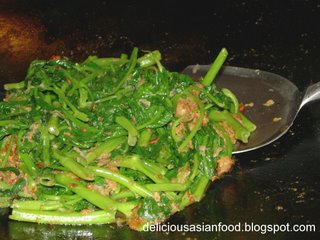
Kangkong Belacan
Water Convolvulus (
or Water Spinach) is also known as
Kangkong in the Malay Language. It is a common vegetable found in abundance in Malaysia and has nutritional values similar to the spinach.
In Malaysia, it is often served as Kangkong Belacan (stir-fried with spicy shrimp paste) or Sotong Kangkong (mixed with cuttlefish in fish paste and sprinkled with crushed peanuts). It is very easy and fast to cook. You should ideally have a cooker with high heat as it is imperative that this Kangkong Belacan dish be cooked as fast as possible. Otherwise, it will be flooded with juice from the vegetable and watery.
 Kangkong and belacan mix
This is my recipe for Kangkong Belacan.
Ingredients- Approximately 400 grammes of kangkong. Separate leaves from stem. Cut stems to reasonable bite sizes
- 50 grammes of belacan (shrimp paste)
- 50 grammes of dried shrimps (pre-soaked in about 150 ml of water. Do not throw away the water)
- 5 bulbs of shallots
- 5 bulbs of garlic
- 4 to 8 red chillis (remove seeds if you want the dish to be less spicy)
- 4 tablespoons of cooking oil (preferably palm oil)
MethodPrepare belacan mix as follows. Pound belacan, dried shrimps, shallots, garlic and chilli in a mortar pound / blend them.
Heat oil in wok till smoke appears from wok. Add oil (which should be heated up substantially). Add belacan mix and stir quickly whilst reducing to medium heat. Do not burn the belacan mix.
Once belacan mix is fragrant and slightly brown, increase heat to high and add kangkong. Stir briskly and add a little water (from the water used to soak dried prawns) if the dish is too dry for your liking. Once kangkong is slightly limp, it is ready for serving.
I usually do not add any seasoning as the belacan and dried shrimps are quite salty in itself.
Technorati Tags Vegetable ,
Recipe ,
sambal belacanLabels: Vegetable
Wednesday, August 09, 2006
posted by pablopabla at 11:31 am
Sorry I have not updated this blog for sometime. I have not been cooking lately until yesterday.

Anyway, I am fond of vegetables particularly broccoli. It's a highly nutritious vegetable from the cabbage family. There are many ways of cooking it. Here, I will share with you how it is stir-fried with other vegetables chinese style.
Ingredients- 150 gms broccoli (cut into florets like picture above)
- 150 gms cauliflower (cut into florets like picture above)
- 100 gms button mushrooms or chinese dried mushroom (if latter, please pre-soak and cut into halves. Remove stem)
- 1 medium sized carrot (sliced)
- 1/2 tin of asparagus clams (optional)
- 100 gms baby corn (optional)
- 4 bulbs garlic (minced)
- 1 1/2 tablespoons cooking oil (palm oil preferred)
- 1 tablespoon corn flour (mix with 50 ml water and stir to make corn starch)
- Half cup hot water
Flavouring- 1 1/2 tablespoons oyster sauce
- 1 teaspoon light soya sauce
- White pepper powder to taste
- 2 teaspoon chinese cooking wine (optional)
Heat oil in wok till oil starts to smoke. Add garlic and mushrooms. Stir fry for 1 minute.
Add cauliflower, carrot, asparagus clams and baby corn. Continue to stir fry for 3 minutes, adding hot water gradually. Cover for 1 minute. Add broccoli and continue to stir fry. Add a little bit more of the hot water if it becomes too dry
(you will want a little bit of sauce).
Add flavouring above and continue to cook until broccoli is slightly limp. If the sauce is too watery, add a little bit of the corn starch to thicken the sauce.
Serve hot with preferably with
rice.
Labels: Chinese, Dinner, Lunch, Vegetable


 Spinach Soup with Hawthorn Berries


